


Percy Grainger: The Free Music Machine Drawings (Non-mint) (Rare edition)
Hardcover | 22.5 x 30 cm | 72 pp
Coracle | 2014 | 9780906630501
Edition of 300 numbered copies
Rare edition
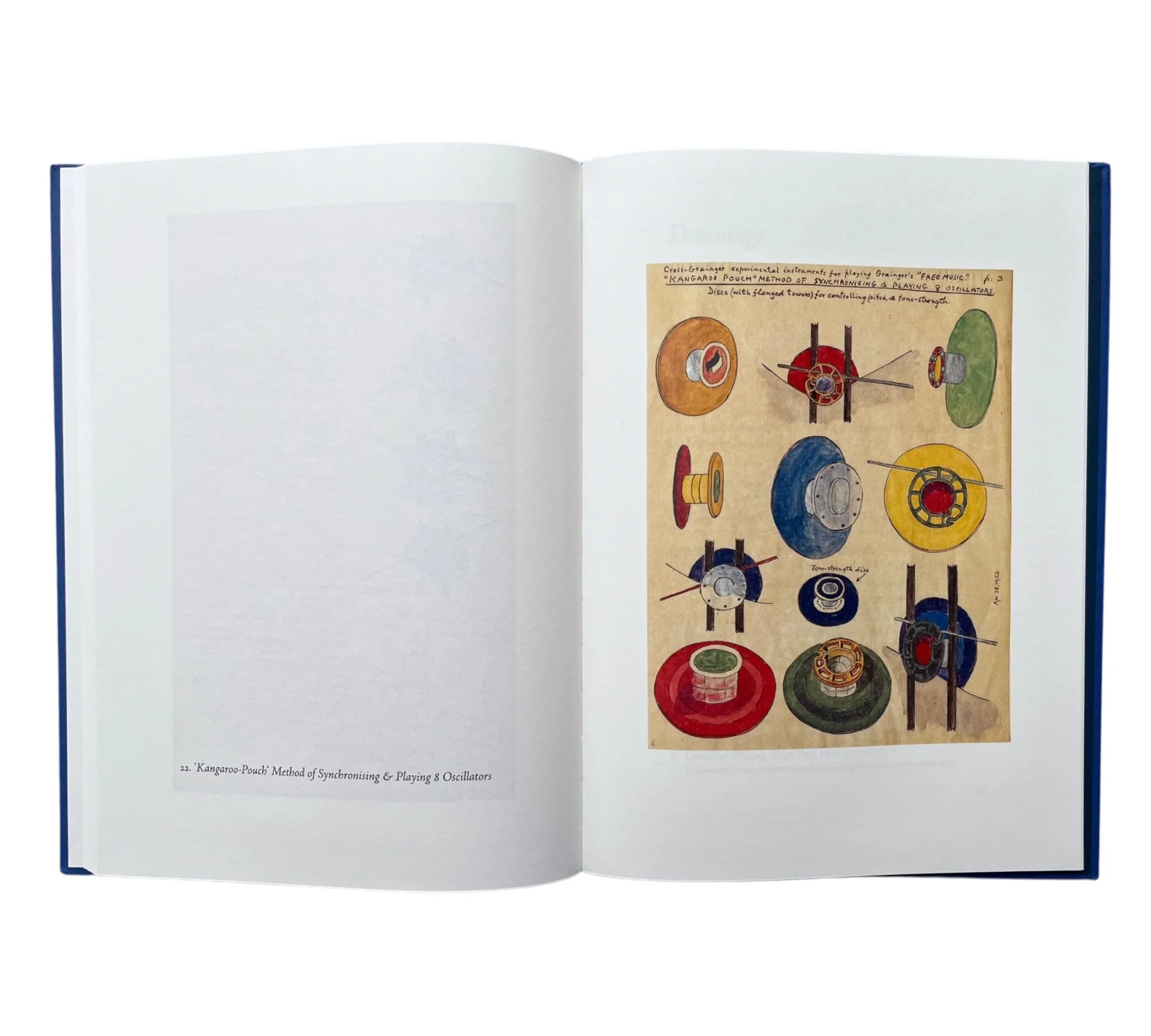
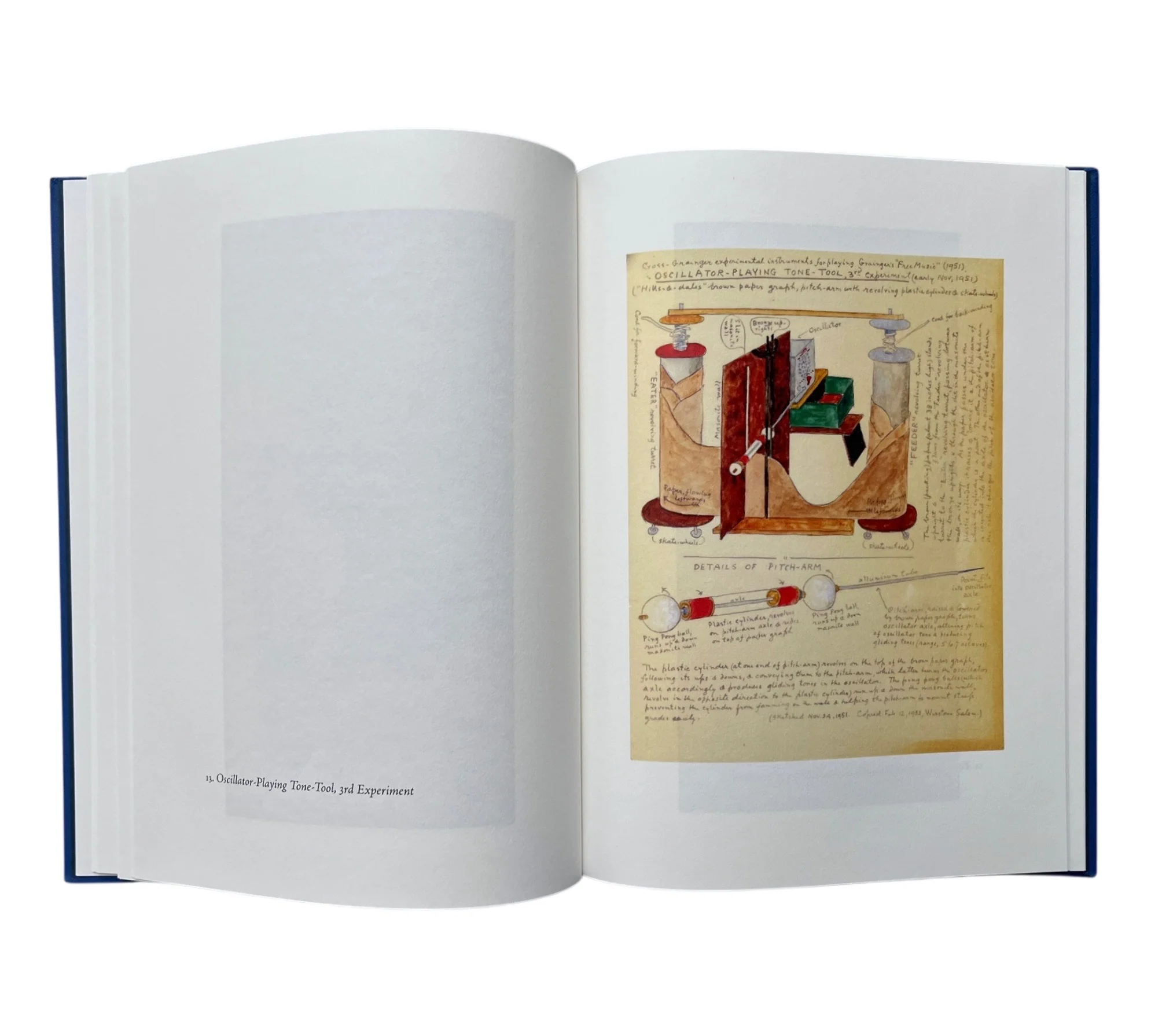
22 drawings by Australian composer Percy Grainger from 1951 and 1952, for the potential Free Music Machines worked on by himself and musician and singer Burnett Cross at that time.
Grainger, a virtuoso Pianist and pupil of Bussoni, had been developing his idea of “free music” since 1900: based on eighth tones and complete rhythmic freedom and unconventionally notated on graph paper. He had experimented using collections of Theremins and changing speeds of recorded sounds on phonograph disks and eventually developed his own instruments.
Graingers experiments with random music composition pre-dated those of John Cage by 30 years with “Random Round” written in the 1920’s. Graingers first experiments used a Pianola “player piano” controlling three Solovoxes by means of strings attached to the Pianola’s keys, this combination was abandoned as it was not possible to create a continuous glissando effect from the Pianola. Grainger started work on a more elaborate but eccentric machine in collaboration with Burnett Cross and his wife, Ella Grainger. The Free Music Machine was a machine that controlled the pitch, volume and timbre of eight oscillators. Two large rollers fed four sets of paper rolls over a set of mechanical arms that rolled over the cut contours of the paper and controlled the various aspects of the oscillators.
The book contains an introductory essay by composer, musicologist and critic Wilfrid Mellers, an erratum bookmark of a poem by the composer Howard Skempton explaining the numerous mis-spellings of Wilfrid Mellers name, and the postscript At Last by the editor of the book, Simon Cutts detailing the precarious history of this project, and its final accomplishment.
PLEASE NOTE: This book is a NON-MINT item. NON-MINT books are new but are either ex-display copies or warehouse marked - minor cosmetic imperfections such as scuffs, marks, or minor dents to the covers
Original: $30.16
-65%$30.16
$10.56Product Information
Product Information
Shipping & Returns
Shipping & Returns
Description
Hardcover | 22.5 x 30 cm | 72 pp
Coracle | 2014 | 9780906630501
Edition of 300 numbered copies
Rare edition
22 drawings by Australian composer Percy Grainger from 1951 and 1952, for the potential Free Music Machines worked on by himself and musician and singer Burnett Cross at that time.
Grainger, a virtuoso Pianist and pupil of Bussoni, had been developing his idea of “free music” since 1900: based on eighth tones and complete rhythmic freedom and unconventionally notated on graph paper. He had experimented using collections of Theremins and changing speeds of recorded sounds on phonograph disks and eventually developed his own instruments.
Graingers experiments with random music composition pre-dated those of John Cage by 30 years with “Random Round” written in the 1920’s. Graingers first experiments used a Pianola “player piano” controlling three Solovoxes by means of strings attached to the Pianola’s keys, this combination was abandoned as it was not possible to create a continuous glissando effect from the Pianola. Grainger started work on a more elaborate but eccentric machine in collaboration with Burnett Cross and his wife, Ella Grainger. The Free Music Machine was a machine that controlled the pitch, volume and timbre of eight oscillators. Two large rollers fed four sets of paper rolls over a set of mechanical arms that rolled over the cut contours of the paper and controlled the various aspects of the oscillators.
The book contains an introductory essay by composer, musicologist and critic Wilfrid Mellers, an erratum bookmark of a poem by the composer Howard Skempton explaining the numerous mis-spellings of Wilfrid Mellers name, and the postscript At Last by the editor of the book, Simon Cutts detailing the precarious history of this project, and its final accomplishment.
PLEASE NOTE: This book is a NON-MINT item. NON-MINT books are new but are either ex-display copies or warehouse marked - minor cosmetic imperfections such as scuffs, marks, or minor dents to the covers